
ABS & Co.: end-to-end digitization of Pakistan's leading full-service law firm
Ahmer Bilal Soofi & Co. (ABS & Co.) is Pakistan's largest full-service law firm by headcount: 40+ lawyers across Lahore and Islamabad, listed in Legal 500, highly recommended by Chambers and Partners, and named Supreme Court Litigation Law Firm of the Year (Pakistan, 2016) by Global Law Experts. AppRocket digitized the firm's public presence end-to-end: a refreshed brand identity, a WordPress + Elementor site sized for a 40-lawyer bench, content architecture covering 12+ practice areas, and the on-page SEO needed to compete with international and regional rivals on legal-services search.
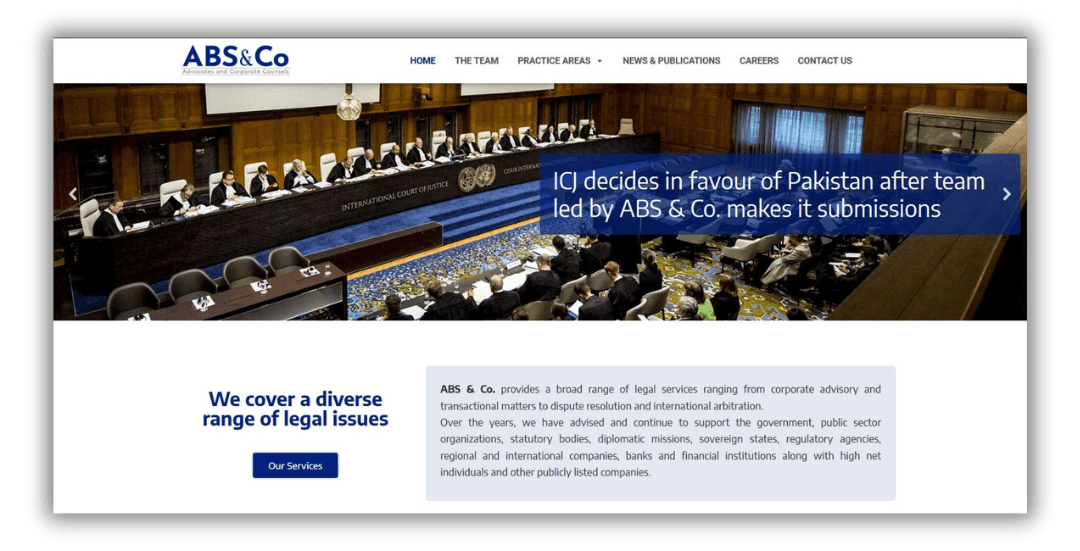
Company Background
Ahmer Bilal Soofi & Co. (ABS & Co.) is Pakistan's largest full-service law firm by headcount: 40+ lawyers across Lahore and Islamabad, listed in Legal 500, highly recommended by Chambers and Partners, and named Supreme Court Litigation Law Firm of the Year (Pakistan, 2016) by Global Law Experts. AppRocket digitized the firm's public presence end-to-end: a refreshed brand identity, a WordPress + Elementor site sized for a 40-lawyer bench, content architecture covering 12+ practice areas, and the on-page SEO needed to compete with international and regional rivals on legal-services search.
ABS & Co. came to AppRocket with a reputation any peer firm in the region would envy and a digital footprint that actively underperformed it. The site predated the firm's expansion to 40+ lawyers. Practice areas were scattered across pages that did not link to one another or surface the relevant lawyers. Structured schema and metadata were absent. The experience degraded badly on mobile, where most legal-services discovery in the firm's market actually happens. The firm was being recommended by Chambers and Legal 500 to clients who, on visiting the site, could not immediately verify that recommendation themselves.
Link to ProjectEngagement
ABS & Co. came to AppRocket with a reputation any peer firm in the region would envy and a digital footprint that actively underperformed it. The site predated the firm's expansion to 40+ lawyers. Practice areas were scattered across pages that did not link to one another or surface the relevant lawyers. Structured schema and metadata were absent. The experience degraded badly on mobile, where most legal-services discovery in the firm's market actually happens. The firm was being recommended by Chambers and Legal 500 to clients who, on visiting the site, could not immediately verify that recommendation themselves.
How we approach this project
We ran the engagement as a single integrated build with four parallel workstreams: brand identity, website architecture and development, on-page SEO, and competitive benchmarking. We treated them as one project so the brand decisions, the URL structure, the schema, and the practice-area positioning could all reinforce each other, rather than being divided across separate vendors who never talk. The build platform was a deliberate choice: WordPress + Elementor for editorial autonomy, schema flexibility through custom post types, and total cost of ownership over a 5-year horizon, disciplined with a tight component library and brand-system enforcement at the template layer.
Client at a glance
ABS & Co. is Pakistan's largest full-service law firm by headcount, founded in 1996 by Ahmer Bilal Soofi (former Federal Minister for Law, Justice & Parliamentary Affairs, and counsel for the Government of Pakistan before the International Court of Justice and ICSID). At the time of engagement the firm operated from offices in Lahore (9 Fane Road, off Mall Road) and Islamabad (12 Embassy Road, G-6/4), with 40+ lawyers, five partners specializing in litigation and three in ADR and international arbitration. Recognition included Legal 500 listing, Chambers and Partners "highly recommended" status as an Asia Pacific Leading Firm, and the GLE Supreme Court Litigation Law Firm of the Year, Pakistan, 2016 award. Notable engagements included the Reko Diq arbitration (TCC v. Government of Pakistan) before ICSID and ICC, the Pakistan Steel Mills privatization before the Supreme Court, and representation of Pakistan in RMI v. Pakistan at the International Court of Justice.
What end-to-end law firm digitization actually means
End-to-end law firm digitization is the simultaneous redesign of a firm's brand, website, content architecture, and on-page SEO so they function as one integrated system rather than as separate, contradictory artifacts. For a firm like ABS & Co. (twenty-five years of practice, four advocates of the Supreme Court, named engagements before the ICJ) the bottleneck was not the absence of substance. It was that the substance was unfindable. The brief was to make the firm's depth visible to the audiences that mattered: Karachi general counsel searching for arbitration counsel, Westminster solicitors searching for Pakistan-side co-counsel, Google's crawlers, Chambers' rankers, and the LLMs that increasingly sit between buyers and law-firm choice.
The challenge in detail
The engagement had to solve five distinct problems at once:
- Discoverability. No structured schema, weak metadata, and a legacy URL pattern meant search engines could not match the firm's pages to queries like "international arbitration lawyer in Pakistan," "corporate counsel Lahore," or "Reko Diq arbitration counsel."
- Content depth. The firm's twenty-five years of work (Supreme Court privatization cases, ICSID arbitrations, FIDIC contract advisory, IP enforcement, regulatory drafting for the Federal Government) was not represented in any browsable, search-friendly form. The depth lived in PDFs, profiles, and partner heads.
- Brand integrity. The firm's identity, while strong in print and in court, did not have a consistent digital expression. Logo, color, and typography varied across templates, social, and signage. Institutional buyers spend weeks looking for trust signals; inconsistency erodes them.
- Team scale. Treat the team page like a product. The 40-lawyer bench needs filtering by practice area, experience level, qualification, and language; alphabetical lists do not scale. The legacy template supported none of that.
- Mobile-first reality. Most legal-services discovery in the firm's target market happens on phones. The legacy site degraded badly there, exactly where most first impressions form.
The full-service nature of the firm made this harder. ABS & Co. is not a boutique with a single anchor practice; its breadth is its product. The digital architecture had to express a wide, deep menu without collapsing into a generic "we do everything" promise, which is the trap full-service firms fall into in search: claiming everything, ranking for nothing.
Our approach, in five workstreams
1. Brand identity refresh: modern aesthetic, legacy authority
The brand brief was to balance modernity with legacy. ABS & Co.'s authority is built on twenty-five years of Supreme Court appearances, government advisory mandates, and named recognition. None of those credentials read well in a 2009 visual idiom. We developed a refined logo and a typographic system that carries across stationery, contracts, the website, social cards, and Google Business Profile imagery without compromise. Color and weight were tuned to read confidently in both English and Urdu contexts, and the visual hierarchy was designed so a junior associate's profile and a senior partner's profile feel like parts of the same firm. That kind of small consistency is something institutional buyers notice. The messaging system was rebuilt around three brand values the partners themselves used to describe the firm (trust, reliability, excellence) with a tone of voice tuned for institutional readers without losing the firm's distinctive courtroom credibility.
2. Information architecture for a 40-lawyer bench
The IA was the most consequential decision in the engagement. We organized the site around three primary buyer journeys:
- "I need a lawyer for X" — buyer arrives knowing the practice area, lands on the area page, sees the relevant lawyers and the relevant work, and books contact in two clicks.
- "Tell me about this firm" — buyer arrives knowing the name, verifies recognition, scans the bench and recent thought leadership, and forms a credibility judgment in 30 seconds.
- "I want to join this firm" — prospective hire arrives needing to verify culture, see the leadership pipeline, and find an application path that signals the firm cares about people rather than CVs.
Each journey received a top-level destination: /areas-of-expertise/, /team/ (with member detail pages), and /careers/. Cross-links between practice-area pages and the lawyers who specialize in them were designed in from the start, so any visitor landing on a practice page was always one click away from the lawyer who could take their matter.
3. Why WordPress + Elementor
The build platform was chosen for three reasons specific to this client and this brief. First, editorial autonomy for the firm's own staff: partners and the marketing lead can publish opinion pieces, case-law commentary, and monthly publications without engineering involvement. Second, schema flexibility across a wide practice-area menu: custom post types and structured fields per practice area, per lawyer, and per publication, designed for clean schema output rather than retrofitted later. Third, total cost of ownership over a 5-year horizon: a modern headless stack would have looked sharper at launch, but the cost of every subsequent edit would have routed through engineers. The discipline imposed in compensation was a tight component library, an enforced typographic scale, and a strict rule that any new visual element had to be approved against the brand system before it could ship.
4. On-page SEO and Google Business Profile
Four interventions that legal-services agencies routinely under-deliver. First, keyword research and competitive analysis modeled at the practice-area level, with ranking opportunities prioritized against the firm's actual depth so the targeting matched practice strength rather than raw search volume. Second, schema markup across Organization, Person (lawyer), and Article (publication) so search engines could resolve who the firm is, who its lawyers are, and what each one practices without inferring it from prose. Third, metadata and on-page hygiene rewritten across every page. Fourth, Google Business Profile enhancement for both offices with verified addresses, hours, practice-area service entries, and imagery sourced from the new brand system.
5. Competitive benchmarking
The competitive workstream was framed at two scales. Regional benchmarking drove the IA, the practice-area emphasis, and the recognition badge placement. International benchmarking, against the firms ABS & Co. actually co-counsels with on cross-border matters, drove the typographic discipline, the brand restraint, and the case-handling rigor on partner profile pages. A Legal 500-listed firm is evaluated by buyers who also evaluate Magic Circle and Vault 100 firms. The website has to clear that bar visually and architecturally, even if it never claims parity.
Architecture and stack
| Layer | Component | Why this choice |
|---|---|---|
| Hosting & domain | Custom hosting on absco.pk | Ownership-class control over hosting and DNS; ccTLD signal aligned with the firm's principal market. |
| CMS | WordPress | Editorial autonomy for non-technical staff; long-tail cost-of-ownership. |
| Page builder | Elementor | Visual editing constrained to a tight component library; safer long-tail edits. |
| Templates | Custom post types per Lawyer, Practice Area, and Publication | Clean schema output and IA discipline. |
| Search & filtering | Practice-area + designation filters on /team/; cross-linked area pages | Buyers find lawyers by what they do, not alphabetically. |
| Mega-menu | Custom mega-menu spanning Areas of Expertise, Team, Publications, Careers | Surface 12+ practice areas without burying secondary entry points. |
| SEO foundations | On-page metadata, H-tag hierarchy, schema (Organization, Person, Article), GBP | Search engines and LLM-driven discovery tools can both resolve the firm cleanly. |
| Analytics | Google Analytics + Google Business Profile insights | Practice-area-level intelligence on which queries are converting. |
| Brand assets | Logo, typographic system, photography, Areas of Expertise imagery, Awards/Recognition imagery | Single brand system across web, social, signage, and stationery. |
What we shipped
| Section | Purpose | Notable elements | |---|---|---| | Home | Authority + entry to the three buyer journeys | Hero, recognition strip (Chambers, Legal 500, GLE 2016), areas-of-expertise grid, recent updates module | | Areas of Expertise (overview) | Full practice menu | 12+ practice areas with imagery and one-click entry to each detail page | | Areas of Expertise (detail) | Where the "I need a lawyer for X" journey lands | Practice description, key work, methodology, lead lawyer contacts, latest updates | | Team (overview) | The 40-lawyer bench, searchable | Search by practice area; designation filters; quick scanning of seniority | | Team (lawyer detail) | Where the "verify the lawyer" journey lands | Career highlights, education, qualifications, awards, recent publications, key practice areas | | News & Publications | A publication archive that gets stronger over time | Partner opinion pieces, monthly publications, company-news updates | | Careers | Talent inbound | People-first narrative; success stories of staff who rose within the firm; application surface | | Contact | Office locations + direct partner channels | Lahore + Islamabad office details; direct routing per partner workflow |
Outcomes
Specific traffic, ranking, and lead-volume numbers are the firm's to share, not ours. The outcomes below are qualitative.
- A coherent digital identity. A single brand system expressed consistently across web, social, signage, and stationery, with a partner team that can describe its own positioning in the same words on the website as in court.
- A team experience that scales with the bench. The 40-lawyer firm is now navigable by practice area, designation, and qualification. Profile pages render the firm's depth (Cambridge LLMs, Yale JDs, Lincoln's Inn Bar-at-Law qualifications, decades of Supreme Court practice) in a form a buyer can actually use.
- Browsable practice depth. Each of the firm's twelve-plus areas of expertise (international arbitration, corporate and commercial, energy, banking and finance, IP, public policy, employment and labor, real estate, dispute resolution, project finance, competition and anti-trust, media and telecommunications) has a destination page rather than living only in PDFs.
- Search engines can see the firm. Schema, metadata, and Google Business Profile work make the firm's pages findable on the queries that match its actual practice depth, rather than the generic legal-services queries it would lose to volume aggregators.
- An editorial workflow the firm owns. The firm's marketing lead and the partners themselves can publish, update, and maintain the site without routing every change through an external developer. That extends the half-life of every dollar invested in the build.
- A documented governance handover. A Website Management Guide was delivered at handover, codifying editorial workflows, brand-system enforcement, and routine operations the firm's own staff would carry forward.
What changed in the 2026 refresh
This case study was originally drafted as an internal engagement summary in 2019. The April 2026 publication is a substantive refresh. Three things are different. Schema and discoverability were upgraded to our current standard: layered JSON-LD @graph (Article, Person, Organization, Service) with a named author byline, dates, and crawler and LLM compatibility. Positioning was sharpened to reflect AppRocket's current focus on US mid-market law firms, with this engagement positioned as the anchor legal case study and the lead proof point on /for/legal-firms/. And the architecture and methodology sections were written out in full: what was a 500-word engagement summary in 2019 is now a longer reference document with the page inventory, the technical decisions, and the patterns that carried into our current playbook for US and international mid-market legal clients.
Patterns that carried into our current legal practice
The ABS & Co. engagement is a foundational reference for AppRocket's current legal practice. Five patterns from this build now show up in our work with mid-market law firms in the US and elsewhere.
- The practice-area page is where buyers convert. The "I need a lawyer for X" journey is how most buyers first land in legal-services search. The home page is a navigation device. The practice-area page is where the buyer makes the call. Every law-firm engagement we've run since ABS & Co. starts there.
- Treat the team page like a product. Search by practice area on the team page is now a default. Profile templates surface the credentials buyers actually evaluate (qualifications, jurisdictions, awards, publication record) instead of alphabetical lists.
- Editorial autonomy is a hard constraint. Law firms publish constantly. Any architecture that routes every publish through a developer dies in the second quarter of operation. The platform decision follows from that.
- Enforce the brand system at the template layer. Every new visual element has to clear the brand system before it ships, and the brand system is enforced through the page-builder's component library, not through a PDF style guide that nobody opens.
- Clear the international bar. Top-tier firms are evaluated by counsel who also evaluate Magic Circle and Vault 100 firms. The website has to clear that visual and architectural bar even if it never claims parity.
Why this matters for U.S. mid-market law firms
AppRocket's current legal practice (focused on AI implementation and digital infrastructure for US mid-market law firms of 50 to 500 attorneys) is built on the pattern recognition this engagement seeded. The firm we partnered with in 2019 had the same structural problem mid-market US firms have today: substantive practice depth that the website fails to render. The interventions that worked for ABS & Co. (practice-area-first IA, search-driven team pages, schema as a first-class build output, and a brand system enforced at the template layer) are the same interventions that compound for a 200-attorney firm in Boston, Chicago, or Atlanta. They are also the digital ground our AI-implementation work sits on. An intake-triage agent is only as useful as the practice-area page that funnels prospects into it. A doc-review agent's output is only as readable as the team page that surfaces the partners who'll review it.
If you run a mid-market law firm and any part of the ABS & Co. brief sounds familiar (substantive practice depth that doesn't show up in your traffic, a team page that can't keep up with hiring, areas of expertise that live in your partners' heads instead of your IA), start with our AI Readiness Audit for Law Firms. It is a 2-week fixed-price engagement that produces the same kind of integrated build brief we wrote for ABS & Co. in 2019, calibrated to the US mid-market today.
FAQ
What does "end-to-end law firm digitization" actually include?
The simultaneous redesign of brand identity, website, content architecture, and on-page SEO so they function as one integrated system. For ABS & Co. specifically: a refreshed brand system, a WordPress + Elementor build, custom post types for lawyer and practice-area surfaces, schema markup, on-page metadata, Google Business Profile enhancement for two offices, a documented governance handover, and editorial-autonomy tooling. It does not, by itself, include AI implementation; that is a separate engagement we run on top of digitized infrastructure for clients who are ready for it.
How long does a build like this take?
The original ABS & Co. proposal scoped four weeks (two weeks of design, two weeks of WordPress + Elementor development), with brand identity and SEO running in parallel. Real-world law-firm engagements rarely land in four weeks because the content workstream (partner profiles, practice-area write-ups, publications archives) runs at the pace of partner availability. Plan on 6 to 10 weeks of calendar time for a 40+ lawyer firm; the build itself is fast, the content collection isn't.
Why WordPress + Elementor and not a modern headless stack?
Three reasons that applied to ABS & Co. and apply to most full-service law firms: editorial autonomy for non-technical staff, schema flexibility through custom post types, and total cost of ownership over a 5-year horizon. A headless stack (Next.js plus a headless CMS) looks sharper at launch but routes every subsequent edit through engineers. WordPress + Elementor, disciplined with a tight component library and brand-system enforcement, lets the firm own the long tail. AppRocket builds on both; the choice follows from how the client publishes.
Do you work with U.S. and international law firms, or only Pakistan-based clients?
Yes. AppRocket's current legal practice is focused on US mid-market law firms (50 to 500 attorneys), with secondary coverage of cross-border and international engagements. The ABS & Co. engagement is the anchor reference for that work, but the patterns carry across jurisdictions.
How do you handle attorney confidentiality and client-data sensitivity in legal builds?
Every law-firm engagement is run under the assumption that client-identifying information cannot leave the firm's perimeter without express permission. Case studies are published in qualitative form by default; specific outcome metrics, client names in matter context, and any matter-level detail are published only with the firm's written sign-off. Our build process avoids storing firm-side data in third-party tools that lack appropriate confidentiality terms. The system we build leaves the firm as the system of record, not AppRocket.
Does this case study include AI implementation?
No, and the distinction matters. The ABS & Co. engagement (2019) was a digitization project: brand, website, content architecture, on-page SEO. AppRocket's current legal practice has expanded into AI implementation for law firms (intake-triage agents, doc-review workflows, conflict-check automations, billing reconciliation), and those are the engagements we scope today for new mid-market clients. The ABS & Co. case study is included on /for/legal-firms/ as a digital-infrastructure proof point; the AI work sits on top of that infrastructure pattern.
Can you provide references from ABS & Co.?
Yes, on request. The firm's principal point of contact during the engagement was the partner team. Day-to-day contact was Bakhtawar Soofi (focus session and design-review lead), with sign-off from Sarjeel Mowahid Minhas (Partner). Direct introductions are available for serious mid-market legal-firm engagements with appropriate confidentiality terms in place.
What changed for ABS & Co.
ABS & Co. now has a single brand system expressed consistently across web, social, signage, and stationery; a team experience navigable by practice area, designation, and qualification; browsable destination pages for each of the firm's 12+ practice areas; on-page SEO, schema, metadata, and Google Business Profile work that make the firm findable on the queries that match its actual practice depth; and an editorial system the firm's marketing lead and partners can maintain without routing every change through an external developer.
- 01Law firm digitization
- 02Legal SEO
- 03WordPress + Elementor
- 04Brand identity
- End-to-end
- Engagement scope
- 40+
- Lawyers across 2 offices
- 12+
- Practice areas surfaced
AI for mid-market law firms
The legal AI playbook the ABS & Co. engagement validates: agent templates, evaluation rigor, and the fixed-price $15K AI Readiness Audit.
Read the playbook Research18 months operating production legal AI
The evaluation-rigor retrospective drawn from our Casetrack product (sunset 2024). The same evaluation framework now used in our legal engagements.
Read the retrospectiveHave the same problem ABS & Co. had?
Start with the two-week audit. We'll scope it against your firm specifically.