
CovidNearby: a privacy-preserving symptom-tracking platform built in 6 weeks that won IEEE Best Paper
A privacy-first COVID-19 symptom tracking platform built in 6 weeks for Rutgers, funded by NIH and NSF. Collected 34,000 voluntary symptom reports using differential privacy. Won the 2022 IEEE Computer Society Best Paper Award and produced 3 research publications.
Company Background
A privacy-first COVID-19 symptom tracking platform built in 6 weeks for Rutgers, funded by NIH and NSF. Collected 34,000 voluntary symptom reports using differential privacy. Won the 2022 IEEE Computer Society Best Paper Award and produced 3 research publications.
Early-pandemic COVID tracking either coerced reporting (mandatory quarantines, forced disclosures) or relied on voluntary self-reporting that people avoided due to privacy fears about location tracking and profiling. The information gap prevented governments and medical facilities from coordinating response. Rutgers — funded by NIH and NSF — wanted to test whether strong anonymity guarantees could meaningfully increase voluntary symptom reporting. The pandemic demanded deployment in weeks, not quarters.
Link to ProjectEngagement
Early-pandemic COVID tracking either coerced reporting (mandatory quarantines, forced disclosures) or relied on voluntary self-reporting that people avoided due to privacy fears about location tracking and profiling. The information gap prevented governments and medical facilities from coordinating response. Rutgers — funded by NIH and NSF — wanted to test whether strong anonymity guarantees could meaningfully increase voluntary symptom reporting. The pandemic demanded deployment in weeks, not quarters.
“They were able to turn around an entire platform within 6 weeks. Kudos to their responsiveness and speed!”
How we approach this project
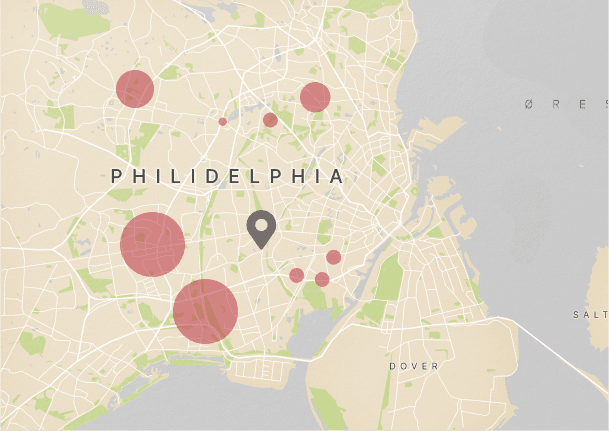
We designed a privacy-first platform. Onboarding collects no personally-identifiable information and requests demographics only as ranges to prevent profiling. Users control an anonymization slider that governs the precision of their location, demographic, and symptom data. Daily symptom check-ins arrive via push notifications with always-available skip. An interactive dashboard overlays two maps: Johns Hopkins COVID case data at national/state/county levels, and a "viewfinder" showing anonymized symptom reports from the surrounding 14 days. Differential privacy is applied mathematically so aggregated queries are useful without revealing any individual.
The challenge
The privacy paradox of pandemic tracking is that the data most useful for public health is also the data people are least willing to share. Mandatory reporting produces compliance without honesty; voluntary reporting produces honesty without volume. Rutgers' Institute of Data, Society and Systems — funded by the NIH and NSF — wanted to test a hypothesis: could cryptographic anonymity guarantees materially increase voluntary symptom sharing? And could we prove it under actual pandemic timelines?
What we built
- Privacy-first onboarding. No PII collected. Demographics requested only as ranges. User-controlled anonymization slider governing location, demographic, and symptom precision.
- Daily symptom check-ins. Simple MCQ questionnaires delivered via browser and push notifications, with skip options and evening re-prompts for missed submissions.
- Dual-map dashboard. One view layers Johns Hopkins CSSE COVID case data at national, state, and county levels. The other — the "viewfinder" — shows anonymized symptom-report density for the surrounding 14 days.
- Differential privacy. Mathematical guarantees that individual data points cannot be reverse-engineered from query results, while aggregate trends remain analytically useful.
- Stack. React for web, Flutter for cross-platform mobile, Node.js backend, MongoDB for flexible schema evolution, Python with NumPy and Pandas for data processing and anonymization, WordPress for static content, all on AWS EC2.
The outcome
- Platform built and deployed in 6 weeks.
- 34,000 users self-reported symptoms over six months.
- Research earned the 2022 IEEE Computer Society Best Paper Award and produced three publications.
- Additional NIH funding secured to modularize the platform into a reusable framework for future privacy-preserving crowd-sensing work.
"They were able to turn around an entire platform within 6 weeks. Kudos to their responsiveness and speed!"
— Hafiz Asif, Assistant Professor (Hofstra) / Postdoc Researcher (Rutgers)
What changed for Rutgers University — Institute of Data, Society and Systems
Turned the entire platform around in 6 weeks. 34,000 users self-reported symptoms over six months. Work won the 2022 IEEE Computer Society Best Paper Award, generated three research publications, and earned additional NIH funding to modularize the platform into a reusable framework for future privacy-preserving public-health data collection.
- 01Healthcare
- 02Privacy
- 03Differential Privacy
- 04Research
- 34,000
- Users self-reporting
- 6 weeks
- Build timeline
- 3
- Research publications
- 2022 Best Paper
- IEEE award
Have the same problem Rutgers University — Institute of Data, Society and Systems had?
Start with the two-week audit. We'll scope it against your firm specifically.