
PaidMeals: a four-role mobile app fighting food insecurity across Brooklyn and Manhattan
A digital marketplace where contributors buy meals from participating restaurants for delivery to those in need. Unifies four user roles in one mobile app. Deployed across 25 NYC restaurants, processed 2,500 donated meals and ~$50K in contributions.
Company Background
A digital marketplace where contributors buy meals from participating restaurants for delivery to those in need. Unifies four user roles in one mobile app. Deployed across 25 NYC restaurants, processed 2,500 donated meals and ~$50K in contributions.
Food insecurity requires coordination between four distinct roles — contributors funding meals, receivers in need, restaurants fulfilling orders, and administrators running the program. Getting all four into a single mobile experience without the interactions collapsing into confusion was the core design problem.
Link to ProjectEngagement
Food insecurity requires coordination between four distinct roles — contributors funding meals, receivers in need, restaurants fulfilling orders, and administrators running the program. Getting all four into a single mobile experience without the interactions collapsing into confusion was the core design problem.
How we approach this project
We applied a four-phase methodology: specification and planning with detailed flowcharts; design thinking sessions that produced a tailored interface for each role; feature-by-feature development treating each interaction as a distinct entity; and continuous QA with rolling client review. The result is one app, four coherent experiences, shipped in 10 weeks.
The challenge
A food-insecurity marketplace is really four apps pretending to be one. Contributors need a simple way to fund meals. Receivers need a dignified way to find and claim them. Restaurants need to manage orders inside their existing kitchen flow. Administrators need oversight. Any of those experiences breaking down breaks the whole system.
What we built
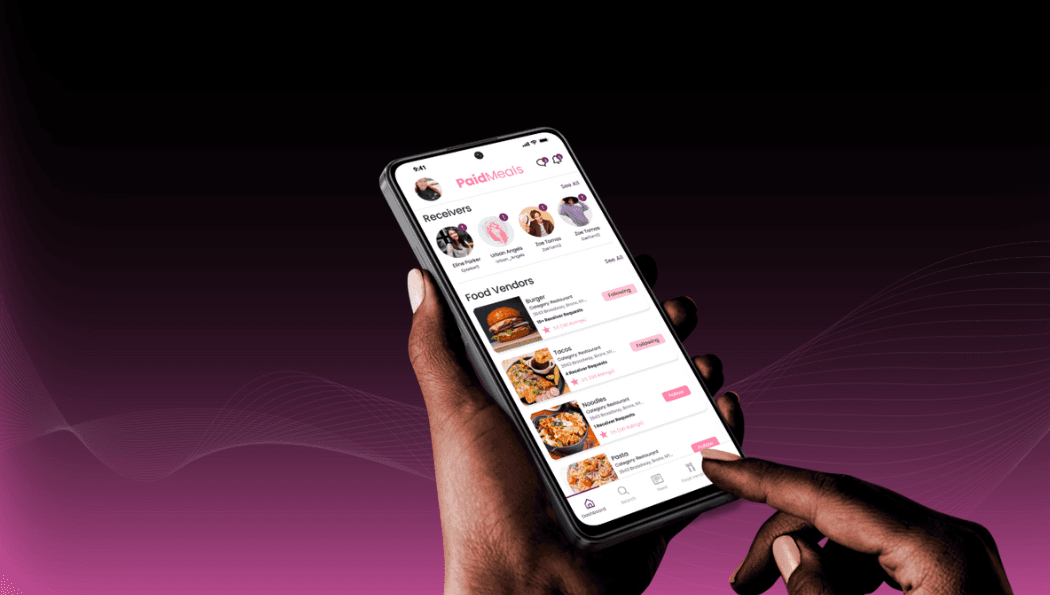
A single mobile application with role-specific flows:
- Contributors. Browse participating restaurants, fund individual meals or bundles, see where contributions went.
- Receivers. Locate, reserve, and pick up meals with minimal friction.
- Restaurants. Accept, fulfill, and reconcile donated orders alongside paid ones.
- Administrators. Monitor deployments, onboard new restaurants, audit transactions.
How we built it
- Phase 1 — Specification. Flowcharts and feature lists locked down before any design work began.
- Phase 2 — Design thinking. Each role got interface decisions made against its actual context, not a generic template.
- Phase 3 — Feature-by-feature build. Every feature treated as a distinct entity with its own interactions.
- Phase 4 — Continuous QA. Rolling testing and client review in parallel with development, not after.
Shipped in 10 weeks.
The outcome
Deployed across 25 Brooklyn and Manhattan restaurants. ~2,500 meals delivered, ~$50,000 in community contributions processed. Live on both app stores.
What changed for PaidMeals
Deployed across 25 restaurants and cafés in Brooklyn and Manhattan, the app has processed roughly 2,500 donated meals and ~$50,000 in contributions. Available on Google Play and the Apple App Store.
- 01Nonprofit
- 02Mobile
- 03Marketplace
- 04Social Impact
- 25
- Restaurants onboarded
- 2,500
- Meals delivered
- ~$50K
- Contributions
Have the same problem PaidMeals had?
Start with the two-week audit. We'll scope it against your firm specifically.